

We are all focussed on driving the best performance, creating the conditions for everyone to deliver the best possible outcomes for the business. We do that by being clear on expectations and priorities, putting collective success ahead of personal agendas, and holding ourselves and others to account for our results. It also means empowering others to do their best work through support and challenge in equal measure.
Each one of us plays a different role in making this happen through our key priorities (ensuring compliance, respecting and protecting the environment and the health, safety and wellbeing of our guests, the communities we visit and our people).
As leaders in our business, our impact and influence to deliver our business goals and demonstrate the expected behaviours cannot be underestimated.

Our performance framework is designed to focus everyone’s attention on our goals and to ensure that we all receive regular feedback and support to perform at our best. Every Officer should understand their responsibilities within this framework, whether they are a manager of colleagues or not.
To deliver the best performance we recognise that our success is equally about ‘what‘ we do and ‘how‘ we do it.
‘What‘ I do
This is my team member’s operational focus, technical skill, knowledge, and application of standards.
‘How‘ I do
This is my team member’s behaviours; how they lead their team, how they interact and impact others, how they interact with guests.
Read more about our Core Values, White Star Service and SHINE
Each of these aspects of our performance are equally important and at the end of each tour 50% of your team member’s appraisal rating is based on the ‘what’ and 50% on the ‘how’; their behaviours.
Everyone’s tour goals should support our business priorities, and if you have annual goals, your tour goals should support these too. To understand how to document your goals and performance tracking, use the examples below:
Goal
What I do: Drive Sustainable Improvement in HESS by operating a safe, reliable and compliant ship
How I do: Coaching to raise standards within team, encourage wider thinking to identify improvements to process, monitor to ensure adherence to new approach
Measures
Measures: Reduce waste by 10% within department
Achievement: Changed the waste segregation process, talked through the new approach with the team, waste reduction of 10% within department
Manager comments
Maria really drove the improvements, gaining buy-in from others, briefed the team well and monitored adherence closely ensuring new approach was embedded
Use the tabs below for full details and documents to support
you in competing the performance framework for an Officer team member
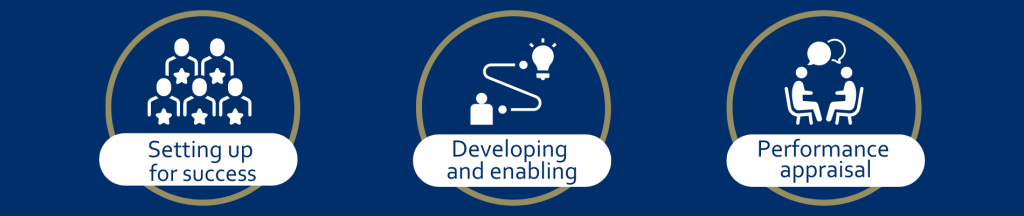
- Setting up for success
- Developing and enabling
- Performance appraisal

It’s important that every officer is set up for success as they start their tour. As a manager, it’s your responsibility to ensure you meet with your team member within two weeks of their boarding. You need to ensure they are clear about:
- The standards that are expected of them in their role and as an Officer.
- Their goals for the tour, which should support our business priorities.
- If they have annual goals, their tour goals should support these too.
Discuss their tasks, ‘what’ they need to do (tasks and goals) and ‘how’ they do it (actions and behaviours), through living our Core Values and demonstrating the White Star Service / SHINE behaviours. Use the icons below to learn more about these.



When setting or reviewing goals set by your team member ensure:
- Goals are relevant to their role and key department targets and accurately reflect the priorities for their upcoming tour of duty.
- They are specific; general, or ambiguous statements are to be avoided.
- Measures of success are clear; agree that these along with their approach and behaviours will be what you will be monitoring and assessing their performance against.
Once you have met with your team member to discuss their tour goals, they should document these on their Goals and Performance Template and share this with you via email.
A useful framework when setting goals:
I will…
- Incorporate a different SHINE/White Star Service or Recovering Brilliantly behaviour into my daily musters.
- Achieve at least five effective safety conversations a month.
- Monitor NPS comments and scores and share feedback with teams at musters.
In order to…
- Improve departmental NPS scores by x%.
- Raise levels of safety awareness in my team.
- Drive Performance and NPS scores to deliver ‘Great Service Consistently’.
By this date…
- Daily
- Monthly
- Once per cruise.
Your team member may be working on a development plan from their last tour. It’s important to review this together to understand the support they may need, how you can monitor progress and provide regular feedback to enable their growth.
All performance discussions must be open and two way. This will enable you to gauge your team member’s understanding and agreement with the targets and measures being set.

Development
We should all continually look to develop our skills, knowledge and behaviours. Regardless of how long someone has performed in their role there are always areas where they can improve their performance. Focusing on driving performance ensures everyone remains passionate about their role with the most up-to-date knowledge.
All officers should have some form of development plan for each tour or one that carries through the performance year. The plan could include:
- Broadening knowledge.
- Working on a project.
- Taking on more responsibilities.
- Managing a difficult situation within their current role.
- Learning new things in preparation of a new role.
You should support your team member to build a plan that meets their needs and aspirations as well as the business needs. Get them to consider the ‘what’ and the ‘how’ in their plan so they can see the type of impact they have on others as well as learning something new.
‘What‘ I do
This is their operational focus, technical skill, knowledge, and application of standards.
‘How‘ I do
This is their behaviours; how they lead their team, how they interact and impact others, how they interact with guests.
Read more about our Core Values, White Star Service and SHINE
Encourage them to broaden their behavioural and leadership skills – many ships have a library of leadership and management material which may support them. In addition, the Learning and Development Officer or HR Manager can also support your team member in thinking through their plan.
Open Cunard Individual Development Planning guide here
Open P&O Cruises Individual Development Planning guide here
Make sure early in their tour your team member has agreed a plan and how you will support them, so you have plenty of time to monitor their progress and provide feedback.
Development plans are not measured as part of the performance reviews, but increased performance or output is. However, a team member’s appetite to grow and the ability to take on new challenges will be important when considering their readiness for career progression.
Enabling success
Monitor your team member’s performance through ongoing 121 conversations – regular feedback drives great performance and supports them to have a successful tour.
Managers should commit to holding 121 meetings regularly, scheduling time upfront with team members. Showing that these meetings are important to you will help your team members feel valued and engaged.
Meeting regularly strengthens relationships and open two-way conversations build trust and this makes it easier to give feedback and maximises performance.
It is not uncommon to struggle to have a tough conversation and this may result in a lack of clarity about what needs to change and how, either because the feedback is too vague or diluted. To enable improved performance, feedback must be a balance of empathy and challenge. Ensure you demonstrate care and empathy while being clear and direct regarding specific behaviours or actions.
Before their 121
- Officers are expected to prepare for their 121s so encourage your team member to send their updated Goals and Performance Template and any additional notes to you prior to the meeting. This ensures you cover their agenda as well as your own.
- Suggest your team member reads the My Performance and appraisal section which guides them on how to prepare.
- Think about what you want to achieve in the meeting that will drive performance.
- Be ready to discuss their progress against goals and achievements, what activity and behaviours have been observed and what was the perceived impact or outcome.
- Be sure to acknowledge great performance, as well as where things could be improved.
During their 121
- Ensure discussions are confidential and held in a safe place.
- Remain flexible if your team member would like to use their 121 to address something different than planned.
- Give every opportunity for them to ask questions and Speak Up if necessary.
- Take the opportunity to provide feedback, but also ask for feedback about your role as their manager; 121s shouldn’t just move in one direction.
- The officer should be clear how they are performing against your expectations so there are no surprises in their end of tour appraisal discussion.
- If you have identified underperformance issues, use 121s as an opportunity to coach and support your team member. Any underperformance concerns should be clearly set out during the tour, so there is an opportunity to address any performance or behaviour gaps before your team member disembarks.

Remember, 121s are a safe space for team members to Speak Up. Use this guide to help you if someone Speaks Up.
Underperforming team member?
If you have identified underperformance issues, use 121 meetings as an opportunity to coach and support your team member. When giving feedback it should be objective (based on observations and not opinion) and clear. Remember these important principles of good feedback:
- Focus on the behaviour or action, not the personality.
- Base on observations, not judgements.
- Be clear and specific to reinforce positive behaviour and actions, redirect unhelpful behaviour and actions, and help the individual understand where they need to focus.
If performance doesn’t improve and you need support, talk to your HRM. Consider a performance improvement plan as a first stage then if required progress to the Performance Improvement Policy. The policy and guidance helps set boundaries so people know what is and isn’t acceptable performance, and the consequences of underperformance.


End-of-tour appraisals are assessed on a three-point scale.
Click here for more information.
End-of-tour reviews need to provide clarity about how the team member has been assessed against expectations and what they need to consider to drive their performance in their next tour.
Before their end-of-tour review
- Arrange a face-to-face appraisal meeting with your team member within two weeks of their disembarkation.
- Ask your team member to think about what they want to discuss; what they think they have done well and what they would like to develop in their next tour.
- Encourage the crew member to ask for feedback from colleagues so they have a view on how they are perceived.
- Ask them to update their Goals/Objectives and Performance Template with their progress and achievements and email a copy to you so you can add your comments.
- Reflect on the performance of your team member against their expectations and goals, consider their performance and behaviours generally and the impact they have had on those around them.
- If appropriate, confidentially gather feedback from your peers so you provide a balanced view of performance.
- If your team member has a shore manager, ensure you gain their input on performance before the review.
During their end-of-tour review
- The conversation should be two-way and supportive, appraisal discussions should be a good experience on which the crew member ends their tour.
- Discuss their achievements against their goals and Core Values/Service Behaviours.
- Acknowledge progress against any development goals and agree any goals to carry forward.
- Celebrate achievements and awards, EG recognition scheme or long service.
After their review
- Complete the appraisal form. Remember your ratings and comments must be objective – based on observations and not opinion.
- Attach the officer’s Goal and Performance Template to the appraisal where requested. (You won’t be able to submit the appraisal form without the attachment.)
- If there are any team member comments, these should also be added to the comments box.
- Once the appraisal is summited, a copy will be emailed to the officers personal email address.
Thank you for helping to drive a step change in business performance by setting clearer expectations and supporting team members.