
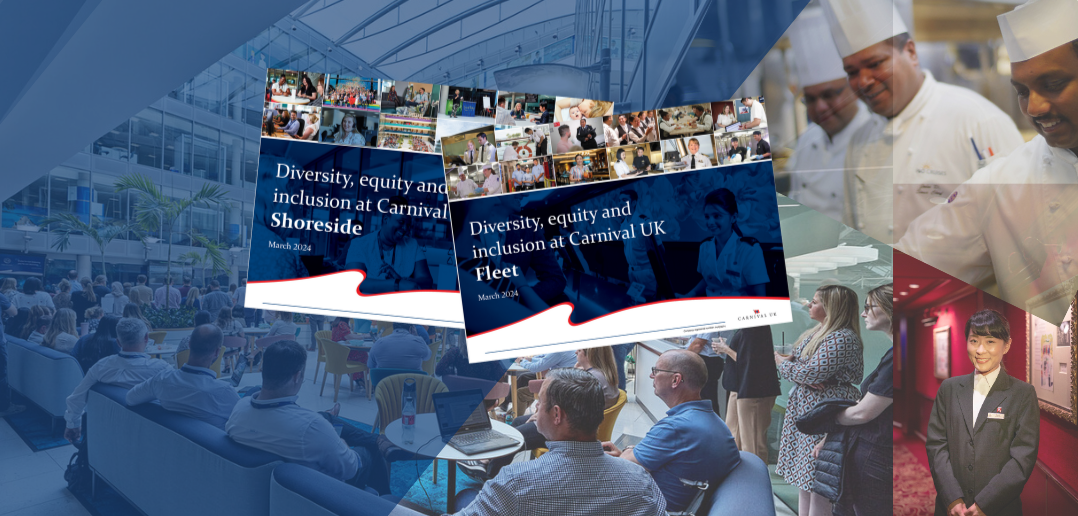
On 3 April, Carnival UK published its latest gender pay gap reports, which measure the difference in mean and median earnings (for pay and for bonuses) between all women and all men across the organisation, across all positions. Our latest reports provide details of our gender pay gap for fleet and shoreside as of 5 April 2023.
We recognise that the current gender pay gap legislation doesn’t consider individuals who identify as non-binary. However, as an inclusive employer we strive for inclusion and fairness regardless of how individuals identify. This year, we’ve created diversity, equity and inclusion (DEI) reports to show how we’re championing DEI for all colleagues at Carnival UK, with gender pay gap reporting as part of this.
Here’s a summary of our gender pay gap
Gender pay is different to equal pay. Equal pay is when there’s no difference in pay between men and women who carry out the same or similar jobs. Gender pay measures the difference between ‘mean’ and ‘median’ earnings for men and women.
Mean gap explained
The ‘mean’ is the ‘average’ found by comparing the average female salary with the average male salary. This time to calculate this, we looked at the average hourly rate of pay of all women and all men at Carnival UK in April 2023.Median gap explained
The ‘median’ is the ‘middle point’ and best understood by thinking in terms of a list. If we listed the salaries of all female employees in order of highest to lowest and did the same for all male employees, the median gender pay gap is calculated by taking the salary that falls in the middle of each list and comparing them.The same mean and median calculations can be applied to determine the mean gender pay gap for bonuses, but for this we look at bonuses paid over a 12-month period up to April 2023.
For more information on what gender pay is and why we report on it watch this short video shared from our reporting back in 2023.
Key headlines – shoreside
Our gender pay gap is reducing slowly, but we have strong female representation across leadership roles at Carnival UK.
Our gender pay gap indicates that more male employees are in positions that command higher pay. Positively, however, we have strong female representation in managerial and senior leadership positions. Since this gender pay gap report, we’ve welcomed Cunard President Katie McAlister which has positively increased female representation on the Executive Leadership Team.
We know the high representation of women in our lower quartiles (i.e., entry level roles) is having the greatest impact on our gender pay gap. To eradicate the gap, we need greater gender balance across all levels of the organisation. We’ll continue our focus on increasing the number of women in senior roles in general while addressing gender representation across our various teams and business areas.
Since 2018, our mean gender pay gap has reduced by 10 percentage points.
Since April 2022:
- Our mean gender pay gap has decreased by one percentage point to 34%.
- Our median pay gap has increased by one percentage point to 38%.
- Our mean bonus gap remains steady and our median bonus gap has decreased by ten percentage points to 71%.
- While the overall reduction in our gender pay gap appears slow, we have strong female representation in our upper and upper middle quartiles and are now gender balanced at levels 5 and 6.
- Our gap is heavily impacted by the high number of women representing our lower quartiles.
Deeper insights into our shore gender pay gap
We decided to go beyond the mandatory reporting to better understand whether there’s any evidence of bias in our practices. Our data shows no difference in the levels of ambition and speed of progression between men and women; performance ratings are equally balanced across genders, and women are progressing at a slightly quicker rate than men at Carnival UK. When looking at the same grade, men and women are also compensated equally overall at the time of hire and promotion.
Grades 6-8 are gender-balanced (51% female), and it isn’t until grade 5 that gender representation begins to skew towards males. Grades 9-15 on the other hand all skew towards females – some as much as 90%. If our entry level roles (CUK9-15) were gender balanced, we would see our gender pay gap lower by around 25%. If our senior roles were gender balanced (CUK0-5), our gender pay gap would lower by around 1%.
Key headlines – fleet
Our 2023 pay gap for Fleet Maritime Services International (FMSI) in particular is positive. However, women are underrepresented on our ships and we’re committed to addressing this industry challenge.
Our fleet DEI report provides details of the gender pay gap for a snapshot of employees working on Carnival UK’s ships Arvia, Britannia and Iona as of April 2023. The employees included in this snapshot work on our ships, but they are employed by Fleet Maritime Services International and Fleet Maritime Services Bermuda (FMSB). As we’re reporting in line with UK legislation, the report only includes data from ships registered in the United Kingdom at the time of the snapshot.
According to the BIMCO International Chamber of Shipping report 2021, the representation of women on board our ships is 10 times higher than the numbers quoted for the global seafarer workforce. However, women are still significantly underrepresented across our fleet. As these patterns are seen across the industry, they require a long-term strategy to address them. Alongside our work to attract diverse talent to our ships, we’re committed to better understanding and improving women’s experience on board. See our full DEI report to find out more.
Since the 2022 snapshot:
- The median pay gap for FMSI has decreased by five percentage points to 0%.
- The mean pay gap for FMSI has decreased by one percentage point to 4%.
- For FMSI, the 2023 snapshot includes 3,368 relevant colleagues for pay (almost 1,700 more than the 2022 snapshot)
- 2023 is the first year reporting the gender pay gap for FMSB. The median pay gap for FMSB is 46% and the mean pay gap is 43%.
- For FMSB, the 2023 snapshot includes 268 relevant colleagues for pay.
- The large difference in headlines for FMSI and FMSB is likely due to the low reportable numbers for FMSB.
It’s important to note that year-on-year comparisons of the gender pay gap for fleet colleagues don’t provide us with a useful trend in data. This is because colleagues working on board at the time of the snapshot can change significantly each year.
For more information read our full reports, shoreside DEI (including gender pay gap) report and Fleet DEI (including gender pay gap) report.
Our goal is to create an environment where everyone can be themselves and for Carnival UK to be known and chosen for its inclusive culture. We continue to focus on creating an inclusive environment to attract the best talent and to enable our people to innovate and grow, whatever their background, belief, or preferences. We’re committed to closing our gender pay gap with long-term solutions focused on a gender-balanced talent pipeline and supporting women to progress their careers with us. If you have any questions about our gender pay gap or DEI reports, please email Heaven White, DEI & Engagement Manager.
2 Comments
One way of decreasing the gap further would be to bringing the pay of the medical staff (female dominated profession) into line with deck and tech officers (majority male) of equivalent rank….
May I ask what drove the need to include 2018 figures? I appreciate you can report a 10% improvement by including 2018, but from 2019 (5 years!) there has only been an improvement of 3%. 2018 to 2019 is a significant outlier to be included and in favour of reporting a higher statistic.
I see comments in the report on how to continue to improve overall but what will be done to increase the rate of improvement? The current rate of improvement, averaged to be less than 1 percentile per year, implies there will still be a gap above the Office of National Statistics 2022’s reported pay gap of 14.9% in 2043 at CUK.
It would be impressive and appreciated to see a plan to improve the rate of improvement increasing year on year in order to reduce the pay gap in a more meaningful way that the current workforce will benefit from.
https://www.ons.gov.uk/employmentandlabourmarket/peopleinwork/earningsandworkinghours/bulletins/genderpaygapintheuk/2022