

Today we’re recognising Time To Talk Day, a day that highlights how much conversation contributes to good mental health.
On board and ashore, we’re asking everyone to show your colleagues and yourself some care, focusing on personal mental health and wellbeing, as well as helping to provide support to peers.
Why talking is important
One in four of us will experience a mental health problem in any given year. We want everyone to feel comfortable talking about mental health – whenever they like. Talking about mental health reduces stigma, helping to create supportive communities where we can talk openly and feel empowered to seek help when we need it.
Free drink and tasty treat at Carnival House, 7 – 14 February:
Check-in* with colleagues in the office and enjoy a free drink and cookie or flapjack. Just go to the Atrium Café as a ‘conversation couple’ to claim your free treats.*Meetings don’t count; it’s all about quality catch-up conversations!
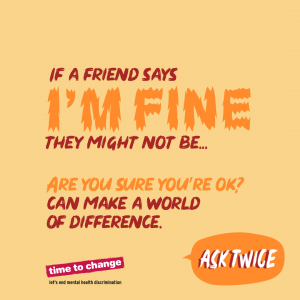
If you see a colleague who looks like they need some support, ask twice if they’re OK. Even if they say they’re fine, they might not be. Check-in again; “Are you sure you’re OK?”
By asking someone twice, we can make it easier for them to talk to us and have an honest conversation about how they’re really feeling. We don’t need to be experts in mental health to listen. We just need to be someone to talk to.
Spot the signs
- Interaction – Has a colleague stopped communicating? Maybe they’re no longer taking calls, participating in group chats or socialising with others on board?
- Withdrawal – Are they participating differently to usual? Perhaps you’ve noticed a change in punctuality or a dip in participation?
- Change – Is there a difference to their usual work output? Have their motivation levels dropped? Or do they keep missing deadlines?
- Struggle – Are they finding it hard to make decisions, to get organised or to find solutions to problems?
- Emotional changes – Are they appearing tired, anxious or withdrawn? Do they lose interest easily?
Read our guide on how to start a wellbeing conversation with a colleague. Although originally created to support people managers, the principles apply to anyone having a mental health conversation.
Wellbeing support and resources
- Finding calm in a stressful world
- Box breathing
- How to manage and reduce stress (booklet)
- Mindfulness (booklet)
- Managing pressure – part 1, part 2, part 3, part 4 (webinar)
- Coping with fear and anxiety (booklet)
- Looking after your mental health (booklet)
- Looking after your mental health (webinar)
- Supporting your mental health at work (booklet)
- Exercise for mental health (booklet)
- Be better with your money (webinar)
- A guide to meditation
- Maintaining a healthy mind in times of uncertainty
If you or a colleague needs urgent medical attention due to poor mental health, call the medical team on board, or (in the UK) emergency services on 999, or the Samaritans on 116 123.
Non urgent support can be found on The Insider here.
Employee Assistance Programme
A free and confidential service set up to support colleagues and their families.
Fleet colleagues
- On board call: 2222-2222-2222 then 222-222 (Colleagues on Iona, you only need to dial 22222 to get straight through to the EAP helpline.)
- In the UK: 0800 917 5319
- Anywhere else in the world: Call your operator for a no call charge and state number: +44.2033183154
- Online: guidanceresources.com (web ID: CarnivalEAP)
Shore colleagues
Find out more about Validium here.
Shore Mental Health Champions
Mental Health Champions are colleagues who can provide confidential support and signpost you to additional help if and when you need it. Find out more about our Mental Health Champions here.