

“Seek help”. “Don’t deal with things alone”.
These can be easy words to hear and think “yes I should probably do that”. But actually doing it is far harder. If you think you need medication to support you with your mental health, or you just don’t know where to start, your General Practitioner (GP) / doctor is probably your first port of call. I have done some research and it looks like in most of the areas we work in, going to see your GP would be the first step to access medical support.
I have been diagnosed with depression previously and I had to take that first step of going to see my GP. However, going to see a doctor about a cough – fine. Going to see a doctor about my feelings – this felt far more difficult! But it shouldn’t be any different. For me, part of the fear of trying to get help was not knowing what would happen. Not knowing what the process would be, what the doctor would want to know, what they would do.
 I thought that if I share my experience then it may help others to take the step if they need it. My direct experience described below took place in the UK, but much of it should be universal. However if anyone based in one of our other countries wants to add details about their local process I will gladly update this with additional information.
As with all appointments, the GP will probably open with a line such as ‘how can I help you today?’ There are a number of approaches you could take.
“I think I might be (depressed, overly anxious, have OCD, PTSD, etc etc)” would be a very direct approach but for me this felt like too scary a statement to admit to myself, never mind anyone else, but some people would rather not beat around the bush.
You could keep it very fact based; “I have been feeling low for X number of weeks and it is starting to affect Y and Z”. You aren’t diagnosing yourself; you are stating the facts as you see them. That puts the ball in the Dr’s court to ask you follow up questions, but perhaps isn’t quite such a scary thing to say out loud.
You could say that someone else suggested you make the appointment; “My partner / friend / family member / work colleague suggested I come and see you because I’ve been down and snappy recently” it doesn’t even have to be true, but it can sometimes feel easier to suggest that it was someone else’s idea to be there.
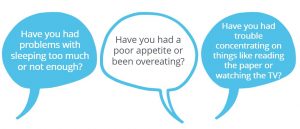
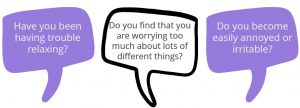
You can say whatever you like to indicate that you are struggling with an element of your mental health. When you have started the conversation, your GP will ask you some follow on questions. These will obviously depend on what symptoms you are discussing.
For depression, this may be things like:
For anxiety this may be things like:
Depending on what you say, your doctor may offer you medication, talking therapy, or a combination of both. You can accept both, one or neither.
The first time I went to see the GP due to depression, she offered me both. However, at the time I would have struggled to leave the house to attend any type of talking therapy. I told my GP this and she was supportive of just starting with medication, but told me that the door was open for her to refer me at another time. Don’t be afraid to be honest about what you need.
Taking Medication for your Mental Health
 I really struggled with the fact that I needed to take anti-depressants. I didn’t want to tell anyone that I needed them; I felt that they indicated weakness and I should be able to sort myself out. I now know that neither of these things is true. You would not (certainly should not!) feel guilty for taking insulin for diabetes, or for taking pain killers because of a broken leg, therefore you should not feel bad for needing to take anti-depressants for depression (or other medication for other mental health issues). There is no weakness in needing medication, and they are a step on the road to you feeling better.
As with all medication, anti-depressants and other similar medications have side effects. Your doctor should tell you about the most common ones when they prescribe it, and may suggest strategies to ease them. For example, some can cause stomach issues so they may say not to take them on an empty stomach. Some can keep you awake, so they suggest that you take them first thing in the morning rather than just before bed.
When I started anti-depressants, the doctor warned me that sometimes things can get worse before they get better, and it can take a couple of weeks for things to stabilise and start to improve. The doctor will probably give you a few days’ worth of tablets to start with (a couple of weeks or a month), and then suggest you go back for a review when you get near to finishing the pack. It is really important that you go back. If you have not felt much benefit, or you aren’t happy with the side effects, there will probably be other options for you to try. It can take a few tries to find the one which will work best for you, but it is important to stick with it and keep trying. Just stopping taking them one day can lead you to feeling even worse than before you started them.
If you read the medication leaflet, there will be some really scary side effects. But it is important to remember that this is the same with all medication, and the odds of you having one of these side effects are really small. The benefits will far outweigh the risks; otherwise the Doctor would not have prescribed them. You can always go back to the doctor early if you are worried.
I hope that sharing my experience is useful. In a future blog I will share more about the talking therapies I have experienced, and other options that are available to you like the employee assistance programme. If you want any more information or just need a chat after a bad day, feel free to get in touch with myself or Eva.
2 Comments
Thank you for sharing your experiences on a very personal topic. It made me think of one of my all time favourite books by Charlie Mackesy (a great read whenever I’m feeling low);
“What is the bravest thing you’ve ever said?” asked the boy.
“Help” said the Horse
Thanks Mel, I’ve seen some of Charlie Mackesy’s pictures on social media but I haven’t read the book, I will add it to my reading list!